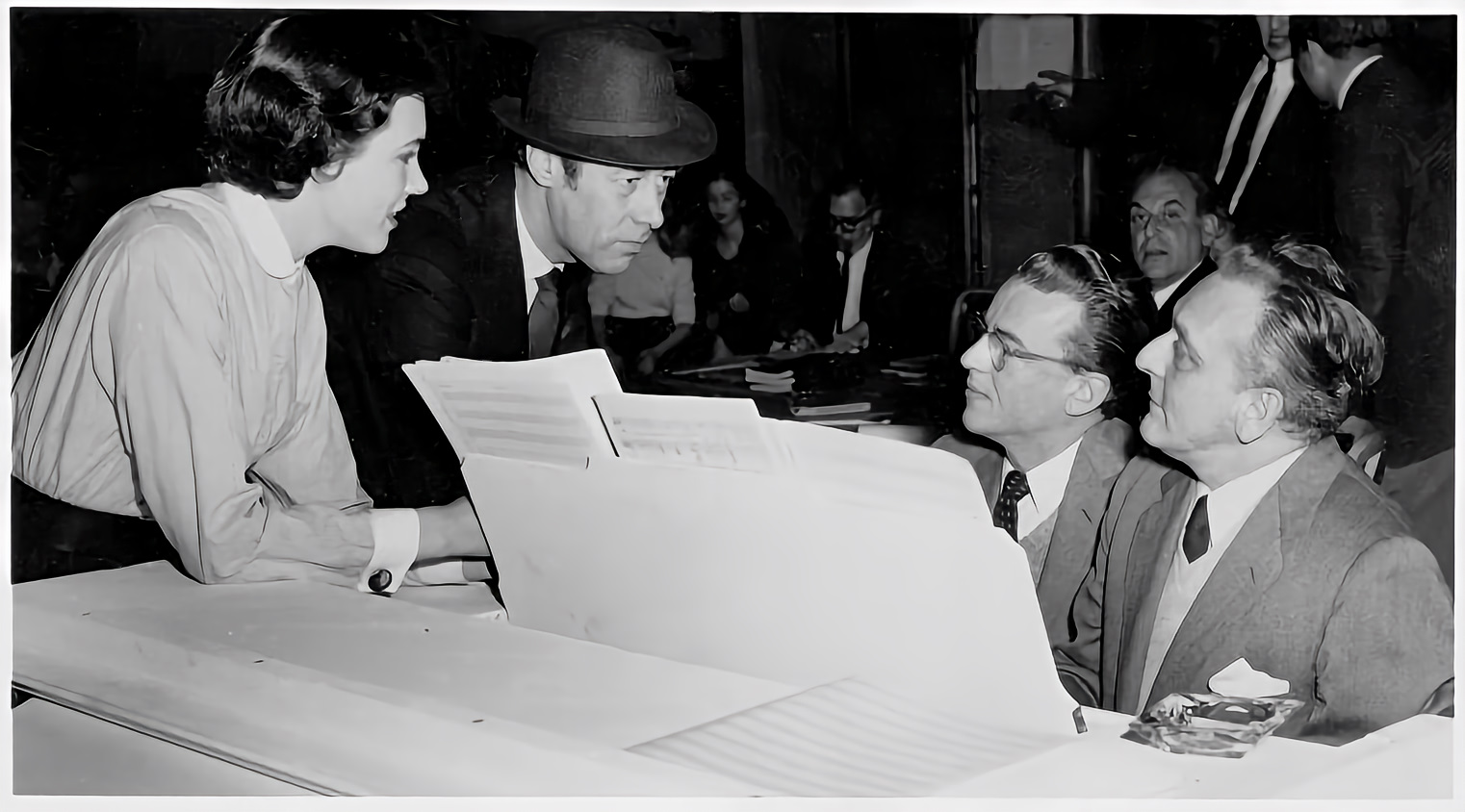
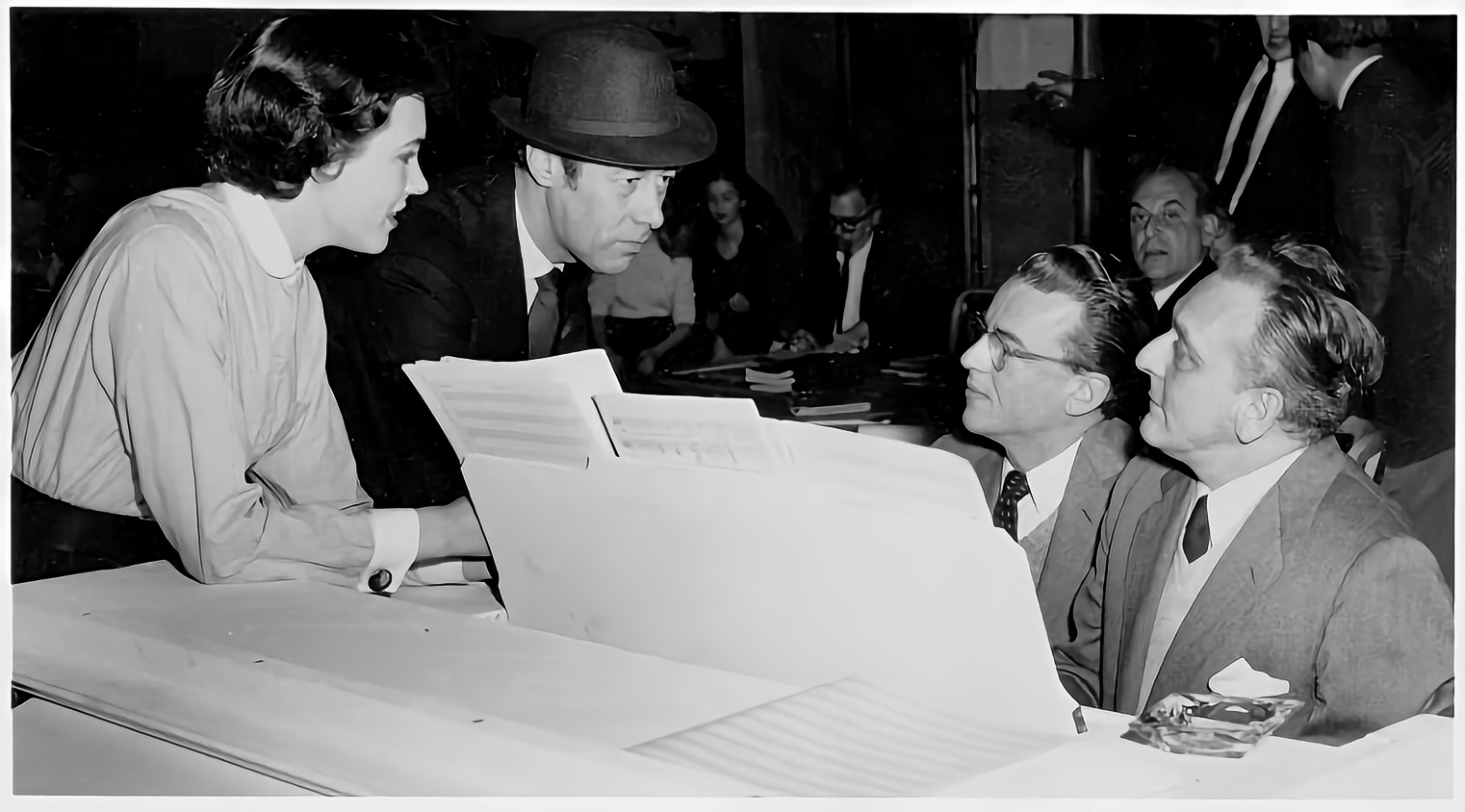
 Julie Andrews and Rex Harrison confer with Alan Jay Lerner and Frederick Lowe at the piano, while Moss Hart looks on in the background (New York Public Library, Billy Rose Theatre Collection)
MY FAIR LADY
The most anticipated Broadway musical at the time. Attempts at obtaining the rights, getting George Bernard Shaw's permission to turn his highly successful play, Pygmalion, into a stage musical, the task of actually turning his play into a musical and having it turned down by the best writers of musical theatre of the day, finding the right cast, overcoming temperamental outbursts by the leading man in a musical because he couldn't sing, realising there were absolutely no places in it for ensemble songs. Add to this the fights between the Director and the Choreographer, one of them would have to go...and one of them DID go, Act One running over half an hour too long during initial out-of-town tryouts, what to cut and what not to cut... it should be as easy as pie to put this one on! Problems, problems and more problems! BUT... as with most things, it all worked out in the end, and everyone was happy!
The Broadway production of My Fair Lady opened at the Mark Hellinger Theatre on the 15th of March, 1956 following the first tryout run at The Shubert Theatre in New Haven in February, and the second tryout season at The Erlanger Theatre in Philadelphia. It was one of the greatest triumphs in American musical theatre history. Rex Harrison played Henry Higgins, 22 year old English new-comer, Julie Andrews, won the critics over as Eliza Doolittle. Stanley Holloway was brilliant as Alfred P. Doolittle and Colonel Pickering was played by Robert Coote. Finishing off the cast were Cathleen Nesbitt as Mrs. Higgins, John Michael King as Freddie, Philipa Bevans played Mrs. Pearce and Christopher Hewett as Zoltan Karpathy. The show ran for 2,717 performances, becoming Broadway's longest running musical at that time.
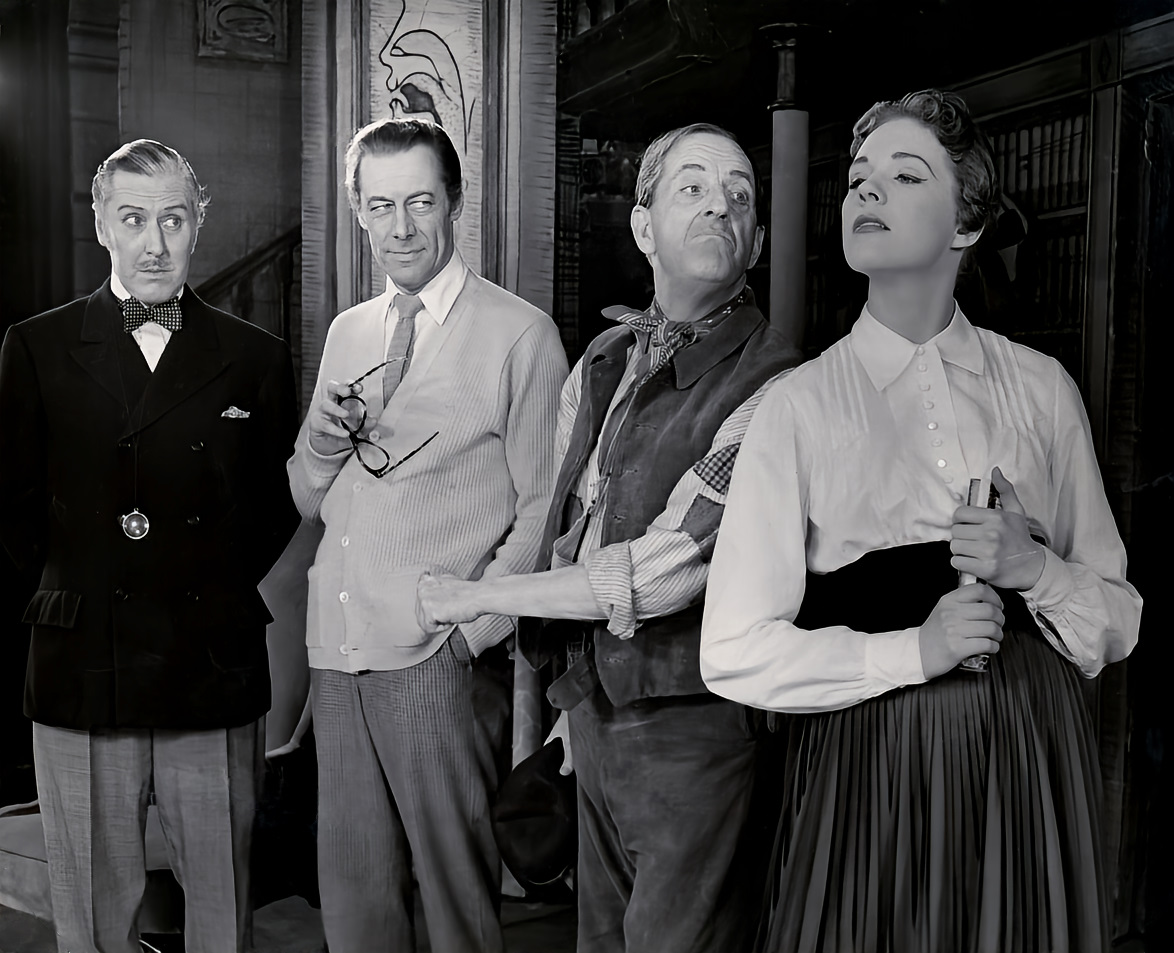 Robert Coote as Col. Pickering, Rex Harrison as Henry Higgins, Stanley Holloway as Alfred P. Doolittle and Julie Andrews as Eliza Doolittle
Film producer Gabriel Pascal had managed to talk George Bernard Shaw into assigning him the rights to produce movie versions of his plays and he produced the highly successful Pygmalion in 1938 starring Leslie Howard and Wendy Hiller in the lead roles. However, Shaw refused outright to allow his works to become musicals following his displeasure over his play, Arms and the Man being turned into the musical, The Chocolate Soldier. A show he particularly disliked.
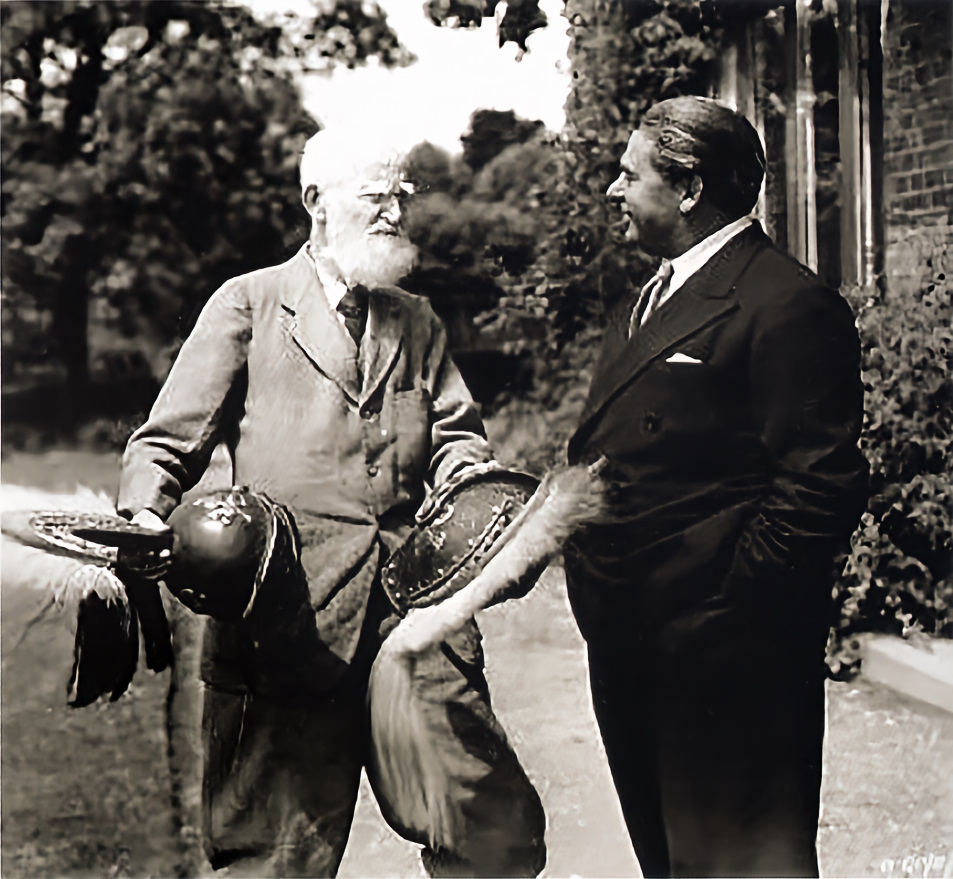 George Bernard Shaw with Gabriel Pascal in 1945 inspecting the helmets from the film version of Shaw's Caesar and Cleopatra
The year after Shaw's death in 1950, Pascal decided to try his luck and turn the play into a stage musical. He originally asked Rodgers and Hammerstein to write the songs but they thought the project was impossible to construct. Cole Porter felt the same, Betty Comden and Adolph Green also turned the job down, as did Leonard Bernstein and Gian Carlo Menotti! Alan J. Lerner and Frederick Loewe took up the job but after months of attempts to get the project rolling, admitted defeat. The main problems with turning the play into a musical were, there was no secondary love story and no real subplot. The main story was not a love story in the traditional sense and there was nowhere for ensemble numbers. The project sat on Alan J. Lerner's bookshelf for a couple of years, untouched.
When Pascal died in 1954, Lerner and Loewe remembered the sketches they had made on a musical version of Pygmalion and revisited their ideas to see what they could come up with. A new ending was added, the emphasis was more on Higgins rather than Eliza, the character of Freddie's sister Clara was dropped and scenes such as the Ascot, the Embassy Ball and Covent Garden market were added to allow for big ensemble numbers, essential to give the story a bigger, broader musical feel. The wheels were in motion for what would become one of the greatest and most loved musicals of all time.
The show was not without its problems during the two out-of-town tryouts. There were mechanical problems with the two revolves a few times during the Embassy transition which meant the chandeliers and ballroom dome couldn't come in. A disappointment for the reveal of the Eliza ballroom costume. Everyone was expecting a huge reaction to the superb, and very costly, white gown which Cecil Beaton had designed, with its bugle-beads and rubies, when Julie Andrews entered the Embassy Promenade scene. Instead.... nothing. Utter silence! They realised she was wearing only one of the many superb gowns in that scene, all but her's having been revealed before her entrance. Solution? A scene was added where Higgins and Pickering are discussing the possibilities of things that could go wrong. Eliza slowly enters from the door at the top of the stairs to the soft, slow strains of "I Could Have Danced All Night". Instant applause! And that moment received applause every night. "On The Street Where You Live" got a lukewarm reception. Disappointed, the decision was made to remove the song from the show, until Alan J. Lerner wondered if it was because the audience didn't realise it was Freddy singing the song, seeing his scene before this at Ascot was where every other man on the stage, bar Higgins, was dressed in the same suit. It was possible. A new verse was written - "When she mentioned how her aunt bit off the spoon, she completely done me in..." nudging the audience's memory, and the song worked like a charm and became an instant hit.

Julie Andrews in Eliza's ball gown

Higgins dances with Eliza at the Embassy Ball, while Zoltan Kaparthy waits to cut in.
Act 1 needed to be cut down so Higgins' song "Come To The Ball" was cut completely, as was an entire ballet, "Dressing Eliza Ballet". A huge cost to remove an entire ballet which had been choreographed, rehearsed, costumes had been made and a setting designed and built. But... out it went. Also cut was "Say A Prayer For Me Tonight", sung by Eliza, and it ended up in the movie Gigi but with different lyrics. Songs which were cut before it even got to previews were, "Shy", sung by Eliza, "Lady Liza" to have been sung by Higgins, the melody of which would become "The Embassy Waltz", and another song for Higgins, "Please Don't Marry Me" which never even got to the stage, as were the song ideas "What Is A Woman?" and "There's A Thing Called Love"..
The removed "Dressing Eliza Ballet" was have been choreographer Hanya Holm's big showpiece in the show, the equivalent of Agnes de Mille's dream ballet in Oklahoma! and her ballets in Brigadoon and Carousel, Jerome Robbins' "Small House of Uncle Thomas Ballet" in The King and I, and his ballets in On The Town. Ms. Holm's ballet didn't even last the initial New Haven tryout run. With the removal of the ballet, the show's big number became the vigorous and exhausting "Get Me To The Church" jig. While it was a huge blow for her to have the ballet removed, after having worked so hard on it, the jig absolutely stopped the show at each performance. As it did in Australia.
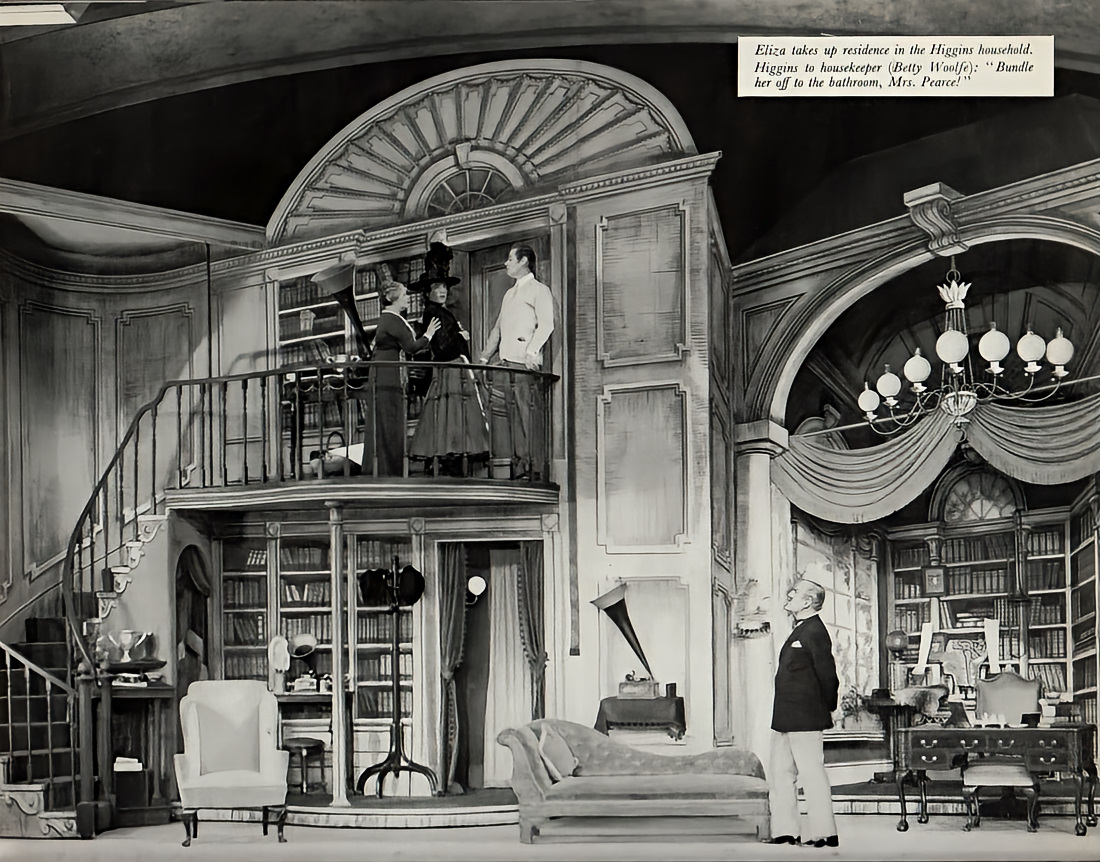
Oliver Smith was entrusted with the scenic designs, the result being some of the most spectacular settings and scene transition scenes to date. The costumes were in the charge of Cecil Beaton, an expert in the Edwardian period, Abe Feder would design the lighting. The superb orchestrations were by Robert Russell Bennett and Philip J. Lang and the dance arrangements were by Trude Rittman.

Oliver Smith's scenic design for Henry Higgin's study

Oliver Smith's scenic design for the Covent Garden Flower Market
Initial thoughts for the title of the show were Liza. Then came Lady Liza. Next came Fanfaroon, an English word meaning someone who blows his own trumpet. Come To The Ball was the next thought, coming from a song which was later dropped from the score. Mayfair Lady was a high contender until, ultimately, My Fair Lady was settled on, the phrase coming from the last part of the children's nursery rhyme, "London Bridge Is Falling Down", the last bar of it quoted in the music leading from the Overture into the opening scene. Alan J. Lerner tells a wonderful story of how it was only two weeks before the first try-out in New Haven and the newspaper layouts had been done but there was only a space for the show's title! "People have got to know the name of the show so they can tell their friends to go and see it!" With no clear decision being made on the final title, Lerner, Fritz Loewe, Moss Hart and producer Herman Levin, decided to go with the title they disliked the least!! After a brief summary of all the titles they had been considering, the one they found "the least indigestible" was My Fair Lady! The best of the bad lot won and after a month or so, they realised it was perfect!
Exhaustive auditions took place, as extensive as those were to be in Australia, with Alan J. Lerner, Fritz Lowe, Moss Hart, Hanya Holm, Musical Director Franz Allers and Cecil Beaton overseeing the proceedings. As in our own production, the singers had to be perfect in cockney AND high-brow accents, the dancers able to handle the ball scene as well as the knees-ups routines, and everyone had to be able to carry off Beaton's costumes. That was as essential as everything else.
-1-1.jpg) Cecil Beaton's costumes for the Ascot scene
Cecil Beaton's costumes for the Ascot scene
The show would win the Tony Award for the Best Musical, Moss Hart won for Best Direction, Rex Harrison for Best Actor in a Musical, Cecil Beaton for Best Costumes, Oliver Smith for Best Scenery and Franz Allers won for Best Musical Direction.
By 1959 the show had grossed around 10 million dollars, breaking box-office records at the time, as it did in Australia and London.

Julie Andrews as Eliza & Rex Harrison as Higgins

Eliza and Higgins dance to "The Rain in Spain"

Pickering and the household staff congratulate Higgins on his triumph